
KNOWLEDGE · warm white vs cool white LED bulb
Warm White vs Cool White: Choosing LED Colour Temperature
Choose LED colour temperature by the atmosphere and task, then compare actual samples. Lower Kelvin values usually describe warmer-looking white; higher values describe cooler-looking white. A CCT number does not tell you brightness or colour rendering, and an adjustable-white bulb needs its control method checked separately.Local preview · November 12, 2026 · Shieldaily Editorial Team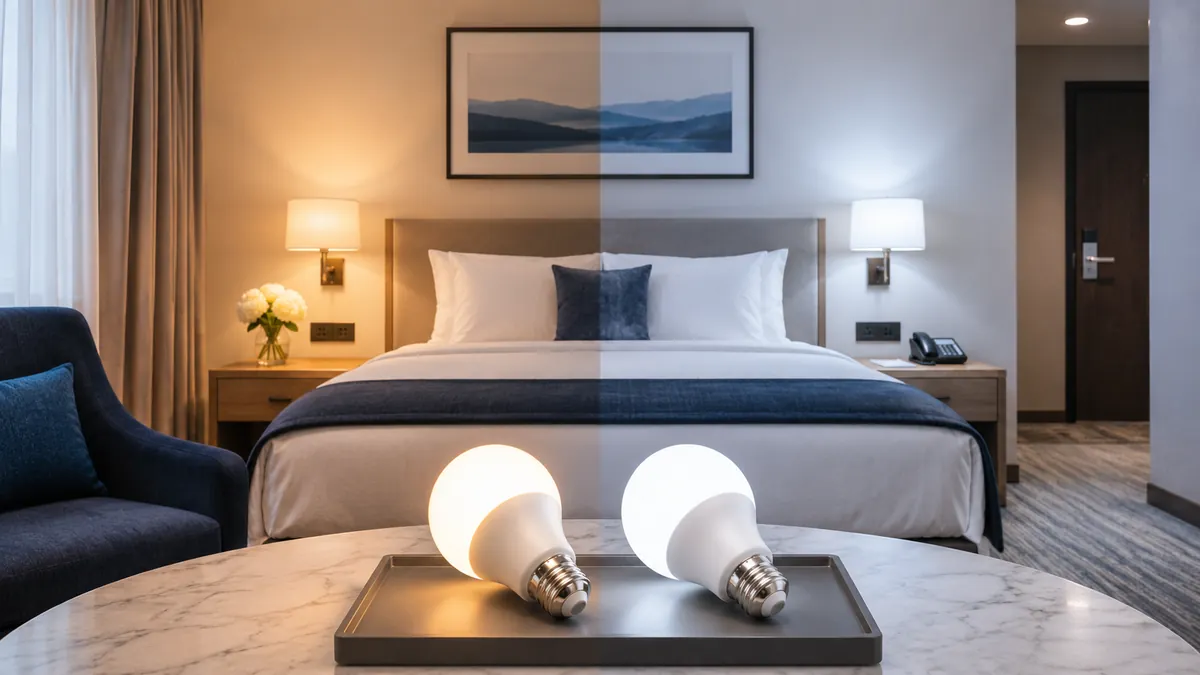
A purchasing brief that says only 'white light' leaves room for visibly different products. Buyers should specify a target CCT, the desired appearance in the room and whether one fixed setting or user adjustment is needed.
The common warm, neutral and daylight descriptions are useful starting points, but photographs and screens cannot establish the final colour. Compare samples under the intended fixture and surrounding materials before approving a carton or product listing. Compare lit samples in the target room because surfaces and surrounding light affect the final appearance.
What Colour Temperature Means
Correlated colour temperature, or CCT, describes the apparent warmth or coolness of white light in kelvin. It is not a measure of power, lumens or colour fidelity. State the required CCT for the exact operating mode and decide whether a tolerance or selectable range matters to the project. Verify the value on the offered model's information rather than inferring it from a marketing name.
Related buyer guide: Lumens and watts comparison
2700K and 3000K Warm White
These lower CCT options generally create a warmer visual impression and are commonly considered for living areas, hospitality and decorative lamps. The best choice still depends on wall finishes, fabrics and the intended mood. Test 2700K and 3000K side by side in the real fitting; two bulbs with the same nominal CCT can differ in tint, output and distribution.

3500K and 4000K Neutral White
Neutral options can suit spaces where a less amber appearance is wanted without moving to a daylight look. In retail or work areas, compare how merchandise, surfaces and faces appear at the intended illuminance. A nominal CCT alone does not establish colour quality. Record lumens and CRI with the chosen setting so the quotation describes the complete light effect.
Compare colour in the intended space
| Compare | Buyer check |
|---|---|
| Warm appearance | Review the sample where a softer atmosphere is intended. |
| Cooler appearance | Review the sample where a crisper visual effect is wanted. |
| Final decision | Use the same room, surfaces and light output when comparing samples. |
5000K to 6500K Cool White and Daylight
Higher CCT settings look cooler and may be chosen for particular task or display environments. They are not automatically brighter than warm variants. Check whether the room or customer preference supports that appearance and whether the offered bulb reaches the required light output at that setting. A sample in the actual space is more useful than a product photograph.
Compare product options: RGB bulb choices
Colour Temperature Is Not the Same as CRI
CRI describes how faithfully colours appear under a source compared with a reference; CCT describes the white point. A bulb can share a CCT with another while rendering colours differently. When colour matters for retail, hospitality or interior finishes, request the relevant rendering data and compare lit objects. Keep CRI and CCT as separate fields in the purchasing brief.
Fixed CCT, Selectable CCT and Tunable White
A fixed-CCT bulb gives one stated white setting. A selectable model may offer a few preset settings; tunable white may allow continuous or stepped adjustment through a controller. Ask how the user changes the setting: installation switch, wall switch, remote or app. Check memory after power returns and make the box instructions describe only the actual operating method.
How Buyers Should Compare Colour Samples
Place the candidates in matching fittings and look at the same surfaces under consistent ambient conditions. Compare the white appearance, output, tint consistency and transition between settings if adjustable. Avoid judging by camera exposure or computer display. Record the chosen sample, mode and model number so production and later repeat orders can be checked against a clear reference.
Plan the market or application: Hospitality options
How to Choose CCT for Hotels, Retail and Homes
In a hotel, coordinate the lamp with room finishes and control expectations; in retail, examine how merchandise appears; in homes, consider the desired room atmosphere and user-adjustment needs. Do not apply one value to every area automatically. Give the supplier the application, fixture and CCT target, then request the variant and sample that match the plan.
FAQ
Frequently asked questions
Is cool white brighter than warm white?
Not necessarily. Compare lumens for the same model and mode. A cooler appearance can change perception without increasing measured output.Does 3000K describe colour rendering?
No. It describes the white-light appearance. Request CRI or other relevant rendering data separately when colour fidelity matters.How is selectable CCT different from tunable white?
Selectable CCT usually offers defined presets, while tunable white provides a broader adjustment path. Check the offered model's actual settings and controller.Why test colour in the intended room?
Surrounding surfaces, fixtures and ambient light affect what buyers see. A sample reveals the result more reliably than a catalogue image.RELATED RESOURCES
Continue your product review
How to Choose LED Bulbs for Wholesale Orders
A wholesale LED bulb buying guide covering market fit, light output, controls, complete-pack pricing, sample testing and written order approval.Read articleE26 vs E27 vs B22 vs E14: LED Bulb Base Guide
Compare screw, bayonet and specialist LED bulb bases, then check voltage, physical fit, labels and sample compatibility for your market.Read articleLED Bulb Sample Approval Checklist Before Bulk Production
A complete sample sign-off guide covering identity, light, controls, dimensions, packaging, written specifications and change control.Read articleHAVE A PRODUCT IN MIND?
Discuss Your LED Bulb Requirements
Share your market, selected product, required functions, quantity and packaging needs so the exact configuration can be reviewed for a quotation.