
KNOWLEDGE · how to choose LED bulbs for wholesale
How to Choose LED Bulbs for Wholesale Orders
Choose wholesale LED bulbs by the market and customer first. Confirm the supply voltage, frequency, base and physical fit, then compare lumens, colour, control method and complete selling-unit contents. Test a representative sample and approve one written specification before ordering in volume.Local preview · November 12, 2026 · Shieldaily Editorial Team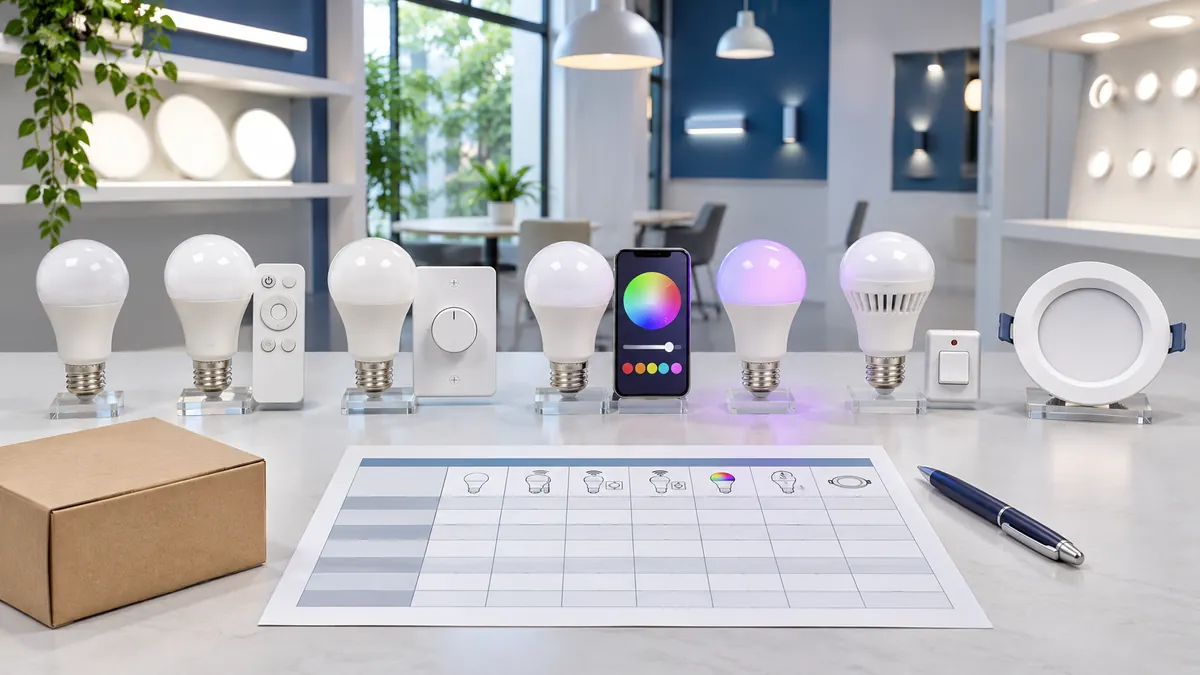
Start with the market, customer and fitting. Then give each supplier the same electrical, lighting, control and packaging brief. Compare the complete selling unit, test a representative sample and approve the final model and pack in writing before a volume order.
Quick product selection
Use the product type to shortlist a sample. Confirm the selected model's functions and electrical variant before comparing quotes.
Swipe sideways to see all five columns →| Product type | Control | Buyer need | Confirm | Sample focus |
|---|---|---|---|---|
| Standard LED bulb | Wall switch | A simple replacement range | Base, voltage, lumens and colour | Fit and light in the intended fixture |
| Remote-control bulb | Handheld remote | Convenient adjustment | Matched remote and pack contents | Pairing, range and multi-bulb response |
| Dimmable bulb | Compatible wall or step control | Adjustable brightness | Exact control method and dimmer | Low-level start, stability and noise |
| Smart Wi-Fi bulb | App and Wi-Fi | Connected room control | Network, app and setup needs | Pairing, reconnection and restart |
| RGB bulb | Selected colour controller | Colour scenes and white light | Colour and white-light modes | Colour, white output and memory |
| Emergency rechargeable bulb | Mains and backup operation | Lighting during a power interruption | Charging and intended backup use | Outage response, brightness and duration |
| Smart downlight | Selected switch or controller | Recessed project lighting | Cut-out, depth, driver and control | Fit, driver and grouped operation |
Start with the Target Market and Sales Channel
Identify the destination country, channel and intended customer before selecting a model. An electrical wholesaler may need a repeatable core range, while an e-commerce seller needs a complete retail unit with accurate imagery and instructions. Describe the fitting or application, the expected order volume and the packaging format. Keep essential requirements separate from optional features so a quoted alternative can be compared fairly.
Choose the brief by sales channel
| Channel | Confirm before requesting a quote |
|---|---|
| Electrical wholesaler | Repeatable electrical variants, base and output, with clear model identifiers. |
| Retail or e-commerce | Selling-unit contents, carton protection, product labels, imagery and user instructions. |
| Hotel or project buyer | Fixture fit, control arrangement, sample acceptance and installation conditions. |
| Private-label brand | Chosen model, logo, rating label, colour box and manual scope. |
| Distributor | Destination markets, core product families and repeat-order identifiers. |
Related buyer guide: Compare lumens and watts
Confirm Voltage, Frequency and Lamp Base
State the supply voltage and frequency used by the customer and the lamp holder or fixture. E26, E27, E14 and B22 are different bases; a similar-looking bulb does not establish interchangeability. For a recessed product, give the cut-out, trim and available depth instead of a screw base. Verify the chosen variant on its label, data sheet and physical sample before approving the order.
Record the electrical fit
| Parameter | Buyer check |
|---|---|
| Voltage and frequency | Use the supply format of the destination installation and the rating of the offered variant. |
| Lamp base | Confirm E26, E27, E14 or B22 against the actual holder; similar appearance is not proof of fit. |
| Downlight cut-out | For recessed models, give opening size, trim diameter, available depth and driver arrangement. |
For recessed options, compare the smart downlight range and check dimensions on a sample.
Compare Wattage, Lumens, CCT and CRI
Watts describe power draw; lumens describe emitted light. Compare both along with colour temperature and colour rendering for the same offered model. The diffuser and beam distribution can also change how useful the light appears in a room. Ask suppliers to state the measurement conditions and test candidates in the intended fitting, especially if one offer promises a different output at a similar wattage.
Compare the same lighting result
| Specification | Buyer check |
|---|---|
| Watts | Compare power draw after the required light level is established. |
| Lumens | Compare rated light output for the same model and operating mode. |
| CCT | Choose the colour appearance that suits the intended space and customer. |
| CRI and distribution | Check colour appearance and where the light lands in the actual fixture. |
Choose the Required Control Method
A standard switch, compatible wall dimmer, step-dimming switch, handheld remote and Wi-Fi app represent different operating paths. Choose the one customers will actually have. If a remote or app is required, list pairing, groups, timers and restart behaviour only when they matter to the offer. Test the selected bulb and control hardware together; a generic 'dimmable' label is not enough.
Match the control to the installation
| Control path | Confirm on the sample |
|---|---|
| Standard switch | Start-up and light appearance in the intended fitting. |
| Wall dimming | The specified dimmer and stable output at low brightness. |
| Step dimming | The switch sequence and levels customers will use. |
| Handheld remote | Pairing, stated range, group response and restart behaviour. |
| Wi-Fi app | Setup, reconnection and basic use after a network interruption. |
| RGB control | Colour selection, white-light mode and memory where offered. |
| Emergency operation | Charging and response when mains power is interrupted. |
Compare remote-control bulbs or smart Wi-Fi bulbs only after choosing the control path customers can use. For wall controls, use the wall versus step dimming guide.
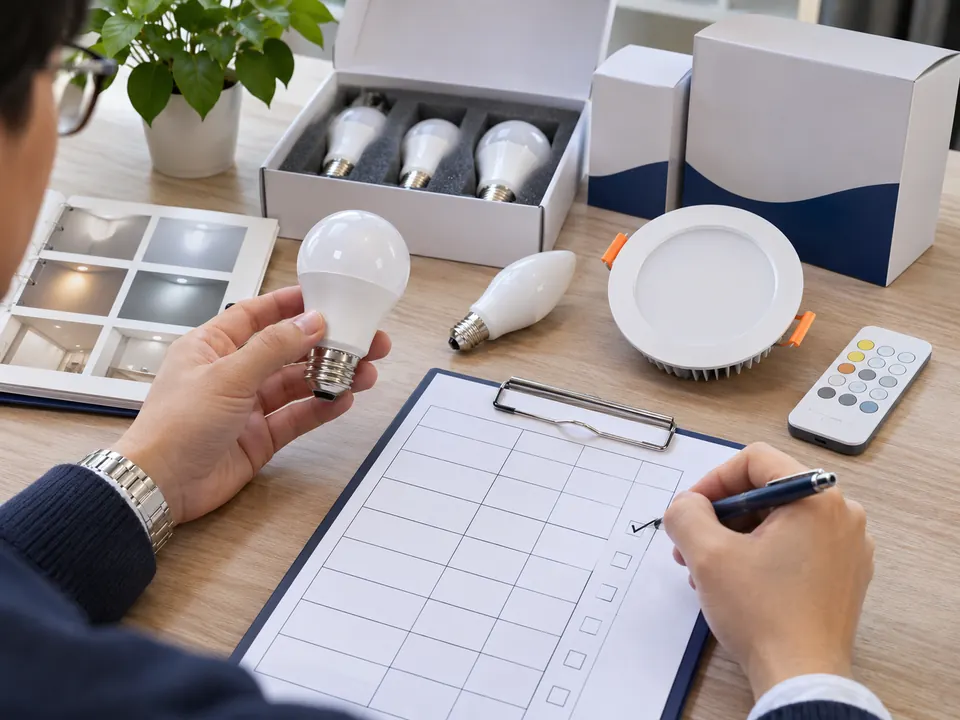
Compare product options: Browse the product range
Compare Complete Product Configurations
Request quotations for the same base, voltage, light output, controller and quantity. A bare bulb and a bulb-with-remote retail pack are different offers even if the lamp is identical. Check whether batteries, driver, connector, manual, labels and cartons are included. Record the exact model and selling-unit contents beside the unit price so the buyer can identify what each figure covers.
Put each quotation on the same basis
| Record | What to compare |
|---|---|
| Exact model | Base, voltage, output, control method and approved sample reference. |
| Selling unit | Bulb, controller, battery if specified, driver or connector where needed, instructions, label and inner box. |
| Carton and quantity | Master carton contents, order quantity and any requested artwork. |
| Commercial terms | Sample cost, stated production lead time and shipping terms for the quoted scope. |
Confirm Packaging and Private-Label Needs
Choose the sales unit before artwork. Specify whether the bulb is sold singly or in a multi-pack, then identify the box, barcode, rating label, manual language and carton marking required by the channel. For private label, provide logo and brand files and ask which changes are feasible for the selected model and volume. Packaging claims must match the tested functions and supplied accessories.
Packaging brief
- Logo and colour-box artwork for the selected model.
- Rating label, barcode, manual language and carton marking.
- Exact bulb, controller, accessory and instruction contents in each sales unit.
Review the feasible scope for the chosen model on the OEM and private-label page.
Test a Sample Before Bulk Production
Use the actual base and supply format, check light output and colour, and operate every promised control. For remote or smart products, test setup, response and restart; for emergency products, test charging and outage behaviour. Compare the pack contents and instructions with the quotation. Record test conditions and any difference so the supplier can revise the exact specification before approval.
Test what makes each product different
| Product type | Sample focus |
|---|---|
| Remote control | Pairing, stated range, several bulbs together and restart state. |
| Dimmable | Low-level start, smooth adjustment, flicker, buzzing and intended dimmer. |
| Wi-Fi | Pairing, app response, reconnection and behaviour without the network. |
| RGB | Colour selection, white-light result, brightness and memory where offered. |
| Emergency | Charging, outage start, backup brightness and measured operating duration. |
| Downlight | Cut-out, trim, depth, driver fit and grouped control where required. |
Approve the Final Written Specification
A sample alone does not record every commercial detail. Confirm the model identifier, electrical and lighting data, controller, artwork, carton quantity, inspection points and shipment requirements in writing. If a component, function or pack changes after approval, review the effect on price, sample and schedule before production. Keep this final record available for repeat orders.
Order process
- Send requirements
- Receive and review a quotation
- Confirm the sample configuration
- Test the sample
- Approve the final written specification
- Proceed to bulk production against the approved scope
- Inspect and accept the delivered order
Plan the market or application: Plan an application
Wholesale LED Bulb Buying Checklist
Before sending a purchase order, confirm the target country, customer channel, voltage, frequency, base or cut-out, bulb shape, watts, lumens, CCT, control method, order quantity and selling-unit contents. Add the approved sample reference, artwork version and required documents. These are the fields that let a buyer compare offers and later check the delivered goods.
FAQ
Frequently asked questions
Should I choose by wattage first?
No. Start with the fitting and required light output, then compare wattage for the same type of bulb. A lower wattage alone cannot establish a useful replacement.Can two quotes with the same bulb wattage be compared directly?
Only after the voltage, base, lumens, controller, pack contents and quantity match. Ask for the complete selling-unit specification beside each price.When is a wholesale sample ready for approval?
It is ready when its electrical fit, light, controls and pack contents match the proposed order. Record test results and the final model in writing before bulk production.What if a supplier offers a substitute model?
Compare the substitute against every essential requirement and request a new sample if a function, component or package changes. Do not transfer the earlier approval automatically.RELATED RESOURCES
Continue your product review
E26 vs E27 vs B22 vs E14: LED Bulb Base Guide
Compare screw, bayonet and specialist LED bulb bases, then check voltage, physical fit, labels and sample compatibility for your market.Read articleWarm White vs Cool White: Choosing LED Colour Temperature
Use LED colour temperature, colour rendering and sample comparison to choose suitable white light for homes, hotels and retail spaces.Read articleLED Bulb Sample Approval Checklist Before Bulk Production
A complete sample sign-off guide covering identity, light, controls, dimensions, packaging, written specifications and change control.Read articleHAVE A PRODUCT IN MIND?
Send Us Your LED Bulb Requirements
Share your market, product type, control method, quantity and packaging needs. Shieldaily can review the brief and discuss a suitable configuration, sample or quotation.